Choosing Miami Beach Private Island Homes vs Condos
April 16, 2026
April 16, 2026
If you are choosing between a Miami Beach private island home and a waterfront condo, you are not just comparing property types. You are deciding how you want to live, travel, maintain, and enjoy your time on the water. In a market shaped by privacy, cash buyers, and lifestyle-driven demand, the right fit comes down to your priorities. Let’s dive in.
Miami Beach includes a wide range of island neighborhoods, but they do not all offer the same ownership experience. According to the City of Miami Beach, its boundaries include Palm, Star, and Hibiscus Islands, the Venetian Islands from San Marino eastward, the Sunset Islands, La Gorce, Allison Island, and Normandy Island.
That matters because buyers often group these areas together as one luxury category, even though they function differently on the ground. Miami Beach is its own city with its own government and city services, while Indian Creek Village is a separate municipality in Miami-Dade County with a very different structure and scale.
For many luxury buyers, this is the first key distinction. A private island home can mean estate-style ownership in a highly limited setting, while a waterfront condo typically means building-based living with shared operations, services, and governance.
Private island ownership tends to attract buyers who want maximum privacy, direct water orientation, and more control over their property. In Miami-Dade, Indian Creek is the clearest example of that model.
According to the village, Indian Creek spans just 0.46 square miles and includes 41 waterfront home sites plus a private country club. That compact footprint creates an unusually low-density environment that feels very different from even the most exclusive condo tower.
One of the biggest draws of a private island is the sense of separation. The Indian Creek Village Public Safety Department states that the village has its own public safety department, and village materials describe a perimeter-security system with radars and thermal cameras to detect waterside intrusion.
The village also notes that residences and the country club connect to the mainland only by the Surfside Bridge. In practical terms, that means controlled access, limited scale, and a level of privacy that is hard to duplicate in other ownership formats.
For some buyers, the appeal is not just privacy. It is the ability to own a standalone waterfront property where you manage the home, grounds, and dockage directly.
Boating is central to the local lifestyle, and the City of Miami Beach neighborhood association resources even highlight a Miami Beach Boaters Association serving Miami Beach and Biscayne Bay. If direct water access and a more estate-like feel are high on your list, a private island home may align more closely with your goals.
Private island homes also sit at the sharpest end of the luxury market. MIAMI Realtors reported that Miami Beach led Miami-Dade’s $10 million-plus single-family sales with 45 sales in 2025, and that the city’s luxury threshold reached $27.5 million, with an uber-luxury threshold of $45.6 million.
In its high-end market report, MIAMI Realtors also found that Indian Creek was Miami-Dade’s top single-family luxury market by median sales price among qualifying homes, at at least $14.8 million. That kind of pricing reflects scarcity, limited supply, and a buyer pool focused on privacy, security, and direct waterfront ownership.
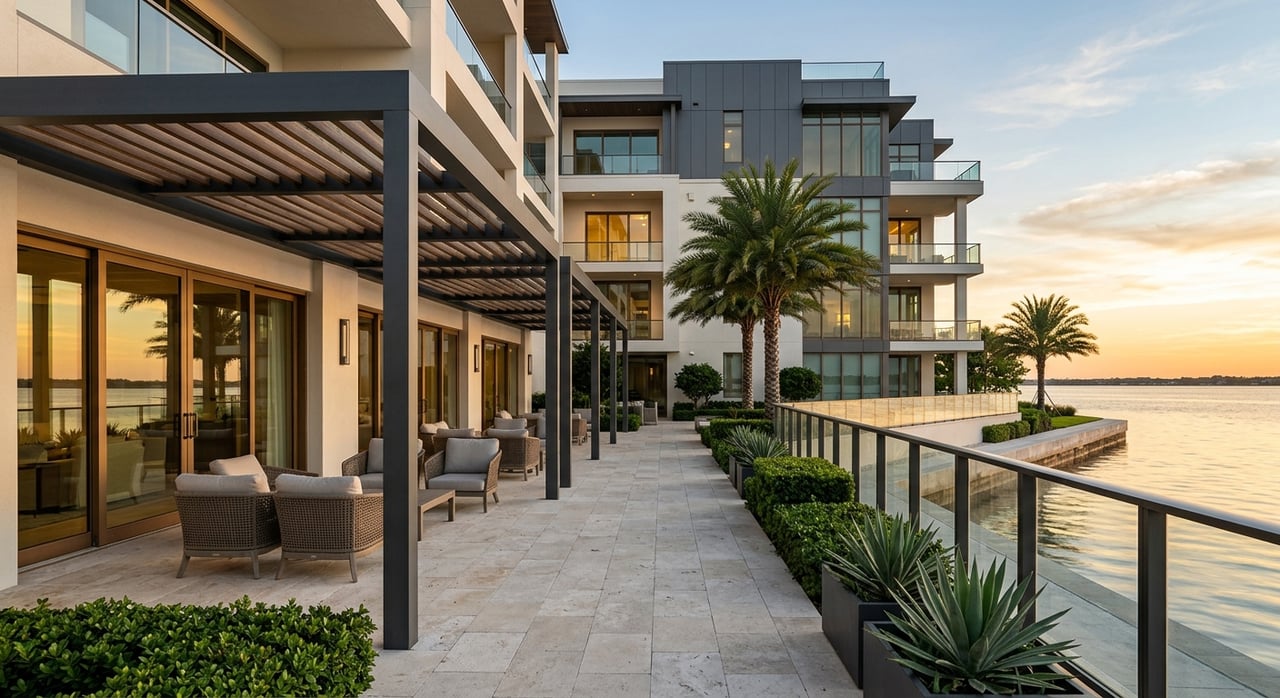
A waterfront condo offers a very different type of luxury. Instead of estate-style control, you gain building services, easier lock-and-leave use, and often a more convenient setup for part-time ownership.
That difference is important in Miami Beach, which MIAMI Realtors ranks as the #2 vacation-home market in the U.S. with 13,817 vacation homes, or 22% of housing stock. In other words, many buyers here are not looking for a full-time estate lifestyle. They want access, simplicity, and flexibility.
Condo ownership can be attractive if you prefer a more turnkey pattern. Building staff, shared operations, and association-managed maintenance can reduce the amount of day-to-day oversight you need compared with a single-family waterfront home.
Security can also be layered differently. The Miami Beach Police Department says it offers hourly police services for private entities and a trespass warning program for enrolled properties. That means many condo communities can combine building operations with city-supported security tools.
One point buyers should understand clearly is the beach itself. The City of Miami Beach states that the city’s beaches are public property and that Miami Beach does not have private beaches.
So if you are comparing a beachfront condo with a private island home, the value proposition is different. With a condo, you are typically buying views, access, amenities, and convenience, not exclusive shoreline ownership.
Luxury condo demand remains meaningful in Miami Beach. In a MIAMI Realtors luxury report, Miami Beach ranked among the top high-end condo and townhome markets, and 91% of $3 million-plus condo and townhome sales were waterfront properties.
Cash is also a major factor. MIAMI Realtors reports that in South Florida vacation-home markets, 76% of condo and townhome sales were all-cash in 2025, and Miami-Dade’s million-dollar condo and townhome market was 70% all-cash. That tells you the upper-end condo market remains deep, competitive, and heavily cash-driven.
If you are considering a waterfront condo, building age, reserves, and inspection records should be front and center. Florida law now requires milestone inspections for residential condo and co-op buildings of three or more habitable stories when they reach 30 years of age, or 25 years in some coastal situations.
According to Florida Statute 553.899, inspection reports and reserve studies must be part of the association’s official records and provided to prospective buyers. The DBPR condo resources also make clear that these records are a key part of buyer due diligence.
This is one of the biggest contrasts with private island ownership. A condo shifts major building maintenance and reserve planning to the association, while a single-family home leaves more direct responsibility with you as the owner.
Age and condition matter in the condo market, especially in Miami-Dade. MIAMI Realtors reported that in 2024 the median sales price for Miami-Dade condo and townhome units 25 years and older was $330,000, compared with $703,250 for units less than 25 years old.
In its 2025 vacation-home analysis, MIAMI Realtors reported that the median Miami Beach condo and townhome price was $500,000, up 7.5% year over year. While the luxury segment operates at a very different price point, the larger trend still reinforces how buyers weigh age, upkeep, and building quality.
If you are narrowing the decision, this side-by-side view can help.
| Priority | Private Islands | Waterfront Condos |
|---|---|---|
| Privacy | Higher degree of separation and lower density | Privacy depends on building operations and layout |
| Access | Often more controlled, sometimes bridge-based | Easier day-to-day arrival and departure |
| Ownership style | Standalone estate ownership | Shared building governance |
| Maintenance | Direct owner responsibility | Association-managed at the building level |
| Boating orientation | Often central to the lifestyle | Varies by building and location |
| Travel use | Better for buyers wanting a private compound feel | Often ideal for lock-and-leave use |
| Due diligence focus | Property condition, seawall, dock, home systems | Reserves, inspections, association records, building age |
A private island home may be the better fit if you want a highly limited setting, direct control over the asset, and a stronger emphasis on privacy, security, and dockage. This path often appeals to buyers who see the property as both a lifestyle decision and a long-term blue-chip holding.
A waterfront condo may make more sense if you value services, easier part-time use, and less day-to-day operational responsibility. It can also be a practical choice if you want Miami Beach access and views without taking on the full demands of managing a large waterfront residence.
Neither option is universally better. The best choice depends on how often you will use the property, how much control you want, and how you feel about maintenance, security, and carrying costs.
In this part of the market, small details have large consequences. A bridge-only municipality, a low-density island, a newer condo tower, or an older building with major records to review can all change the ownership experience in meaningful ways.
That is why the comparison should go beyond listing photos and headline pricing. You want to look at lifestyle fit, legal structure, maintenance burden, and resale dynamics with the same care you give to architecture and location.
If you are weighing Miami Beach private islands against waterfront condos, a tailored strategy can save time and sharpen your decision. Jessica Adams Luxury Real Estate offers a white-glove, design-aware approach for discerning buyers navigating South Florida’s most distinctive luxury properties.
We've got more to share with you.
October 1, 2026
August 27, 2026
September 24, 2026
September 17, 2026
Neighborhoods
June 25, 2026
A New Home Changes Everything.