Old Cutler Bay Skipped the Membership Committee. The Prices Didn't Notice.
September 24, 2026
September 24, 2026
A buyer closing on a home in Old Cutler Bay won't find a club application anywhere in the paperwork. There's no interview, no board vote, no nonrefundable initiation fee standing between an accepted offer and a set of keys. What that buyer will find, tucked into the county tax bill, is a line item that has nothing to do with a private homeowners association at all. It's an assessment tied to the Old Cutler Bay Security Guard Special Taxing District, a mechanism the City of Coral Gables created by ordinance in 1993 and still administers today. For the tax year that began October 1, 2025, the charge runs $4,900 on an improved lot and $2,450 on a vacant one, and unlike a typical HOA due, it attaches to the property as a lien until it's paid. The Miami-Dade Security Guard Special Taxing District dataset maps this arrangement, and a 2018 Coral Gables city attorney opinion lays out how the city funds and staffs these districts through off-duty police officers rather than a private guard service.
That's the neighborhood's actual gatekeeping mechanism: not a committee that decides who's in, but a public agency billing for what's already there. Old Cutler Bay has operated as a voluntary homeowners association since June 1986, and membership approval has never been required to buy or lease inside its gates. A few hundred yards north, in Gables Estates, the arrangement runs the opposite way: buyers submit to a private club and pay a steep nonrefundable membership fee before they're allowed to close. One neighborhood screens. The other doesn't. And the pricing data says almost nothing about that difference matters as much as buyers might assume.
Old Cutler Bay sits between Cocoplum and Gables Estates on Biscayne Bay, three of the handful of Coral Gables enclaves the city still lists as recognized homeowners' associations on its South Waterways advisory board. Line them up by how a buyer actually gets in, and the contrast is sharp.
| Enclave | How you get in | Governance | Where it lands on price |
|---|---|---|---|
| Old Cutler Bay | No approval required; voluntary HOA since 1986 | City-administered security taxing district, billed on the tax roll | Ultra-prime, roughly on par with Gables Estates |
| Gables Estates | Club membership with a nonrefundable fee | Private club governance | Ultra-prime |
| Cocoplum | HOA application and fee; exterior changes need approval | Private HOA | Prime, trading below both neighbors despite faster percentage gains |
An early-2026 review of Coral Gables waterfront pricing put Old Cutler Bay and Gables Estates on the same plane, both commanding roughly a 70 percent premium over Cocoplum, and both up in the neighborhood of 162 percent over the prior decade. Cocoplum actually posted the bigger percentage gain, closer to 175 percent, but it started from a lower base, and a bigger percentage move off a smaller number still leaves it trading beneath its two neighbors in raw dollars per square foot. If governance were what drove price, Old Cutler Bay's open door should have left it priced closer to Cocoplum, not tied with the community that makes buyers apply for admission. It isn't. Something else is setting the ceiling.
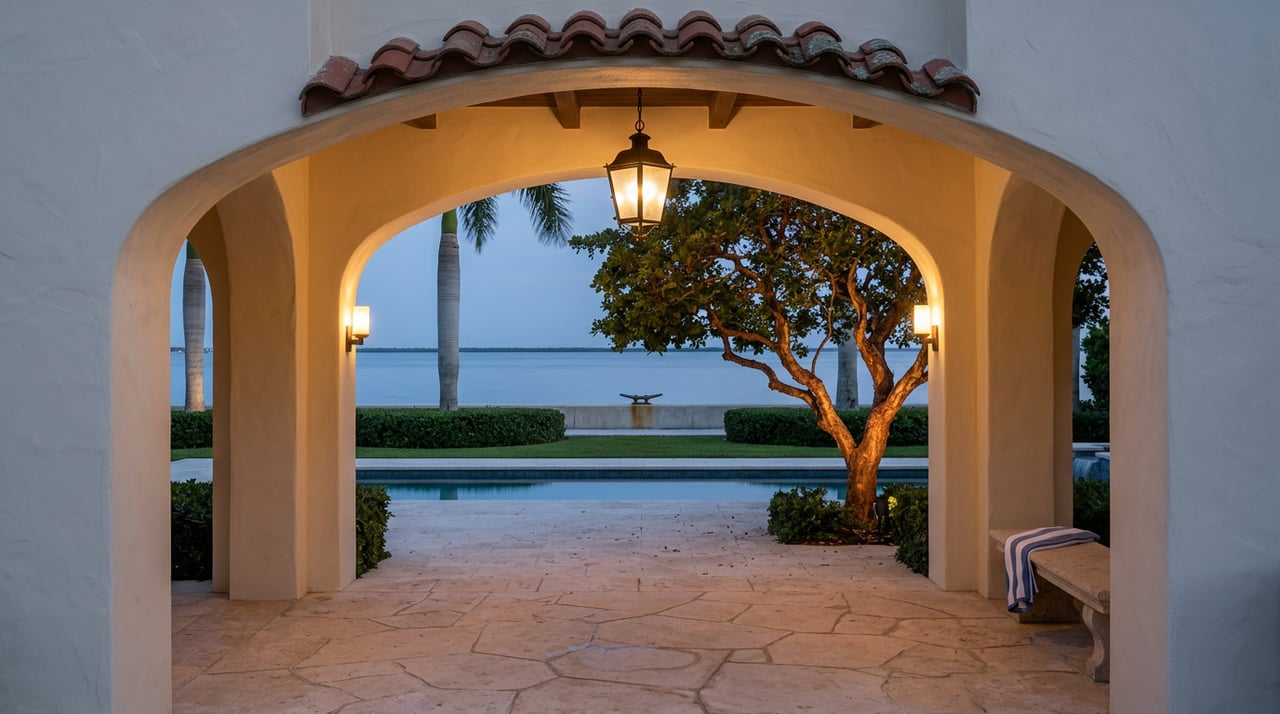
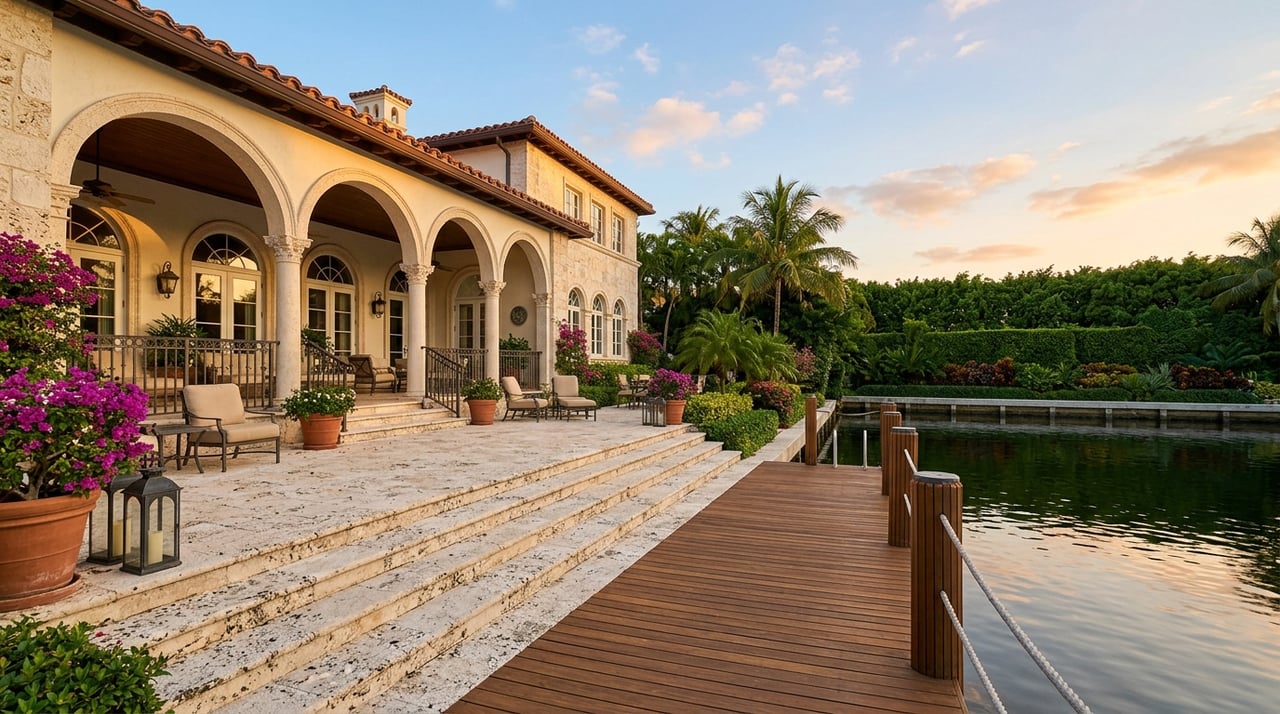
Old Cutler Bay was platted in the early 1960s, and its calling card has always been the water, not the gate. Of its roughly 136 homes, about 127 sit on canals with no fixed bridges between the dock and Biscayne Bay. That detail matters more than it sounds like it should. A fixed bridge caps the height of whatever passes under it, which caps the size of boat a homeowner can keep at the dock. No bridge means no ceiling, and for a certain kind of buyer, that single fact does more to set a home's value than any club roster ever could.
You can't legislate more no-bridge canal frontage into existence. Gables Estates has it. Old Cutler Bay has it. Cocoplum, for portions of its waterfront, doesn't have it to the same degree, and that's a more plausible explanation for the pricing gap than anything having to do with who reviews an application. The entrance to Old Cutler Bay still carries a marker of that history: a 10-foot wrought iron sculpture called "A World of Its Own," donated by the community's developer, Albert Aronson, and dedicated in 1965. It has outlasted plenty of the original houses around it. Homes in the neighborhood date from 1964 to as recently as 2020, on lots that average around 24,600 square feet carrying homes that average about 4,680 square feet, which means a buyer touring the neighborhood today is really touring two different housing stocks at once. Original one-story canal houses from the community's first decade sit a few doors down from ground-up rebuilds sized for a different era of boats and buyers.
That split housing stock shows up directly in the sales data, and it explains something that looks, at first glance, like a contradiction. One tally of Old Cutler Bay's MLS activity, covering the twelve months through March 2026, counted just four closed sales, averaging $24.2 million and roughly $2,682 a square foot, with homes sitting unsold for an average of 218 days before closing. A separate tally, taken about six months earlier and covering roughly the prior six-month stretch, counted seven sales priced between $3.45 million and $7.795 million, averaging about $683 a square foot.
Line those two windows up and they overlap almost entirely, yet they describe what look like two unrelated markets. The per-square-foot gap alone is close to fourfold. That's not a data error. It's what happens when a single set of 136 gates contains both a trophy tier that trades rarely at bay-frontage prices and a working tier of smaller or already-updated homes that turn over in months rather than years.
For anyone pricing a listing here, the practical takeaway is to figure out which tier a given home actually belongs to before reaching for a comp. A renovated four-bedroom on a smaller lot has more in common, timeline-wise, with the $3 to $8 million turnover tier than with the neighborhood's headline sales. A ground-up estate on wide no-bridge frontage is going to draw from the same thin, patient buyer pool that Gables Estates draws from, and it should be marketed and priced with a nine-month runway in mind, not a ninety-day one.
Do I need board approval to buy in Old Cutler Bay? No. It has operated as a voluntary homeowners association since 1986, and there's no membership review process standing between an accepted offer and closing.
What is the security assessment, and is it the same as an HOA due? It's a city-administered charge tied to the Old Cutler Bay Security Guard Special Taxing District, established by Coral Gables in 1993. For the tax year beginning October 1, 2025, it runs $4,900 on an improved lot and $2,450 on a vacant one, and it's collected on the county tax bill rather than invoiced separately, which means it behaves like a lien if it goes unpaid rather than like a typical HOA statement.
Are all the homes in Old Cutler Bay on the water? Most, but not all. Of the roughly 136 homes in the community, about 127 sit on canals with no fixed bridges to Biscayne Bay. The remainder are interior lots without direct water access, and that distinction shows up in both price and how quickly a given home tends to sell.
Old Cutler Bay is a good reminder that the things that make a Coral Gables waterfront address expensive aren't always the things that make it feel exclusive. A club roster can be built almost anywhere. A canal with no bridge between the dock and the bay cannot. If you're weighing this stretch of Old Cutler Road against its more heavily gated neighbors, or trying to figure out which tier your own dock actually sits in, Jessica Adams Luxury Real Estate has spent years reading these enclaves lot by lot. Start Your Luxury Search when you're ready to talk specifics.
We've got more to share with you.
September 24, 2026
September 17, 2026
Neighborhoods
June 25, 2026
September 10, 2026
July 16, 2026
A New Home Changes Everything.