Camp Biscayne vs Hughes Cove in Coconut Grove: Which Fits?
August 27, 2026
August 27, 2026
Ask an appraiser to comp a home in Hughes Cove and watch what happens. One tracking snapshot covering 2022 through 2024 counted just four closed sales inside the enclave over that entire stretch. Camp Biscayne is not much busier. Between them, these two gates hold somewhere between twenty and forty homes total, depending on which source you trust for the count, and neither enclave sells often enough to generate a real comp set in any given year.
That is the first thing a buyer comparing Camp Biscayne to Hughes Cove needs to sit with. The question is not which enclave is nicer. The question is what each one is actually pricing, because the two are not pricing the same thing at all.
Most Grove buyers start this comparison the way they would compare two condo buildings: square footage, price per foot, amenities, done. That approach works when a market trades often enough to generate a pattern. It falls apart here.
Hughes Cove has been variously listed at 9, 12, and 15 homes across different tracking sources, and Camp Biscayne anywhere from 11 to 26. The spread is not sloppy research. It reflects how rarely these enclaves change hands, how little standardized reporting exists for them, and how much of what does sell moves through private introductions rather than open listings. When a market this thin does produce a sale, that single transaction can move the perceived value of the whole enclave, because there is no larger sample to average it against.
This matters for negotiation as much as for pricing. A buyer walking in assuming a Hughes Cove listing can be checked against "recent comps" the way a Ponce Davis or Pinecrest listing can is working with the wrong toolkit. The appraisal here is closer to appraising a piece of art than a house. History, dock engineering, and canopy condition carry weight that a standard comp grid was never built to hold.
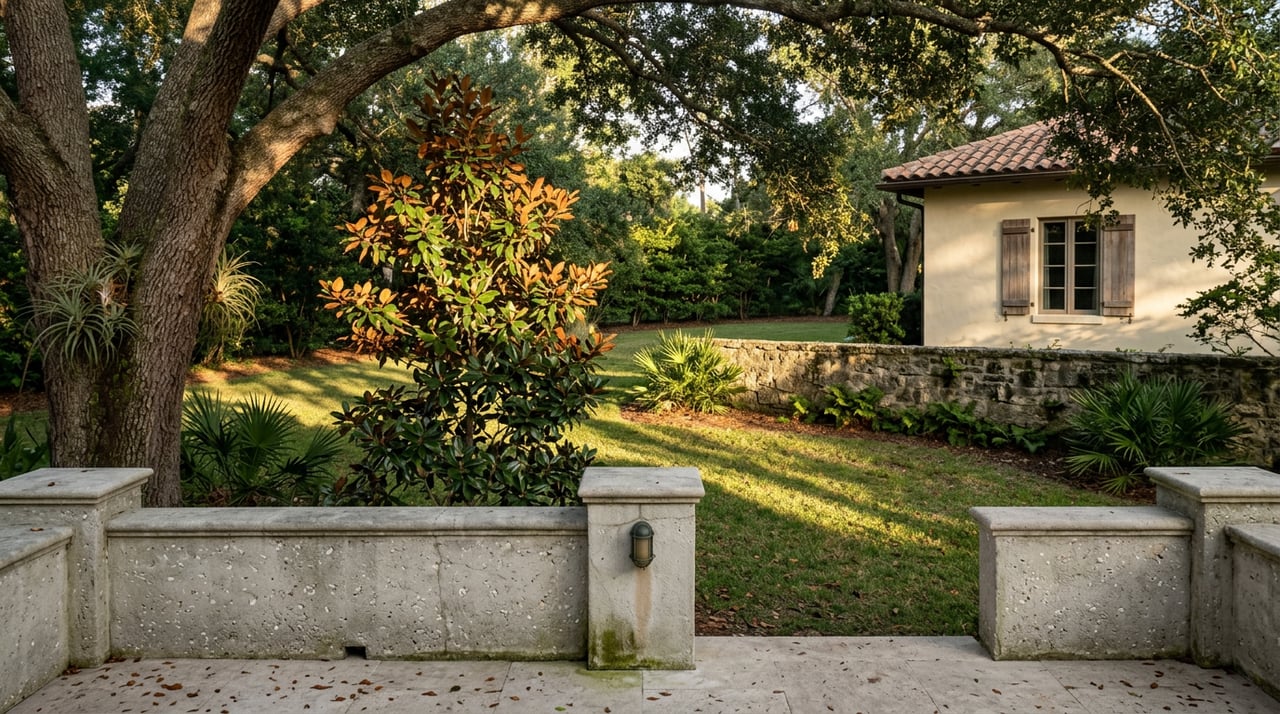
Camp Biscayne's story starts with the same man who built the Barnacle. Ralph Middleton Munroe, Coconut Grove's first Commodore of the Biscayne Bay Yacht Club and the designer of fifty-six yachts over his lifetime, founded Camp Biscayne in 1903 as a winter resort, a stopping place for sailing and fishing guests after the old Peacock Inn had closed. He built it a few lots south of his own home, on land he had already spent years working to keep in its natural hammock state rather than clearing it.
Munroe named each of the resort's original cottages after a native or ornamental tree, tagged the trees themselves, and handed guests a list so they could learn the names as they walked the grounds. Guests over the resort's run included Alexander Graham Bell. The resort closed in 1925, and the land it sat on eventually became the residential enclave that exists today, still carrying that instinct toward preservation in its mature tree canopy.
That history is not decoration. It is the asset. Camp Biscayne's homes sit on lots reported between 14,000 and 70,000 square feet, with structures ranging from roughly 1,500 to 8,000 square feet, and not every home touches the water. Some sit purely on land, under canopy, with no dock at all. In an enclave built this way, the premium is not uniformly tied to bay frontage. It is tied to the grounds themselves, the same grounds Munroe worked to keep intact more than a century ago.
Hughes Cove tells a completely different origin story. The land once belonged to Howard Hughes, and the enclave that carries his name was built out between 1993 and 2004, roughly a century after Camp Biscayne's founding, as a small, purpose-built cluster behind a 24-hour manned gate at the end of Devon Road, off Main Highway.
The reason serious boat owners single it out has nothing to do with acreage. It comes down to one structural detail: Hughes Cove's private boat basin opens to Biscayne Bay without a fixed bridge in the way. In Coconut Grove, that combination puts it in the company of only one other enclave, The Moorings, as an address where a large vessel can reach open water directly from a private dock rather than being capped by bridge clearance somewhere along the route.
That single engineering fact is why multiple market sources tracking Coconut Grove's gated enclaves through 2026 flag bridge clearance as the factor buyers most often overlook when comparing waterfront listings on paper. A canal lot with a fixed bridge between the dock and the bay can look identical to a bridge-free lot in a listing photo and trade for meaningfully less, because the boat that fits under one bridge does not fit under all of them. Hughes Cove was built to remove that ceiling entirely, and pricing in the enclave reflects it: waterfront homes there have traded at roughly $866 per square foot against approximately $401 per square foot for the community's non-waterfront homes, a gap of more than double for the same gate and the same zip code.
| Camp Biscayne | Hughes Cove | |
|---|---|---|
| Founded | 1903, as a winter resort | Built out 1993 to 2004 |
| Homes | Roughly 11 to 26, by source | Roughly 9 to 15, by source |
| Defining asset | Mature hammock canopy, mixed waterfront and dry lots | Private, bridge-free boat basin |
| Typical lot | 14,000 to 70,000 sq ft | Quarter acre to just under an acre |
| Price signal | Land and grounds carry premium regardless of water access | Waterfront homes command roughly double the per-square-foot price of non-waterfront homes |
Set side by side, the pattern is plain. Camp Biscayne is priced as a piece of Coconut Grove's early history, still shaded by the same hammock Munroe refused to clear. Hughes Cove is priced as marine infrastructure, a small cluster of homes built around one very specific piece of engineering that most of the Grove's waterfront does not have.
Neither is more exclusive than the other. They are exclusive in different currencies.
If the pull toward the Grove is about pedigree, shade, and a lot large enough to feel like private ground rather than a waterfront strip, Camp Biscayne answers that question, and it does so whether or not the specific home carries a dock. If the pull is a boat, especially a large one, and the ability to leave the dock without checking a tide chart against a bridge schedule, Hughes Cove is solving a problem Camp Biscayne was never built to solve.
The mistake is trying to run one against the other on a spreadsheet. A Camp Biscayne home without a dock is not underpriced relative to a Hughes Cove waterfront home. It is a different product being sold to a different buyer. Recognizing that early changes how you approach the offer, because you stop trying to argue a Hughes Cove seller down to Camp Biscayne per-square-foot logic, and you stop expecting a Camp Biscayne interior lot to carry a marine premium it was never built to carry.
Coconut Grove's overall median sat at roughly $2.7 million as of February 2026, and waterfront gated inventory across the neighborhood was averaging just over $1,100 per square foot in early 2026 market tracking. Both of these enclaves sit well above that baseline, but for entirely different reasons, which is exactly why a single neighborhood-wide number cannot tell you which one is right for you.
Both are thin by design. Camp Biscayne and Hughes Cove are each small enough that a single year can pass with no listings at all, and when something does surface, it often moves through private conversation before it reaches a public portal.
Some of its lots do touch the water, but the enclave was not engineered around a single unobstructed basin the way Hughes Cove was. Bridge-free access in Camp Biscayne would depend on the specific lot and its position relative to the bay, not on a shared enclave-wide feature.
Both communities transact rarely enough, and largely enough off-market, that different trackers end up counting slightly different inventories at different points in time. Treat any published count as an approximate range rather than a fixed number.
If you are weighing Camp Biscayne against Hughes Cove, or trying to figure out which one actually matches what you want out of a Grove address, Jessica Adams Luxury Real Estate has spent years inside both gates. Start Your Luxury Search with a team that knows the difference between buying land and buying a dock.
We've got more to share with you.
October 8, 2026
October 1, 2026
August 27, 2026
September 24, 2026
September 17, 2026
A New Home Changes Everything.