Buying On The Water In Gables By The Sea: Key Questions
June 18, 2026
June 18, 2026
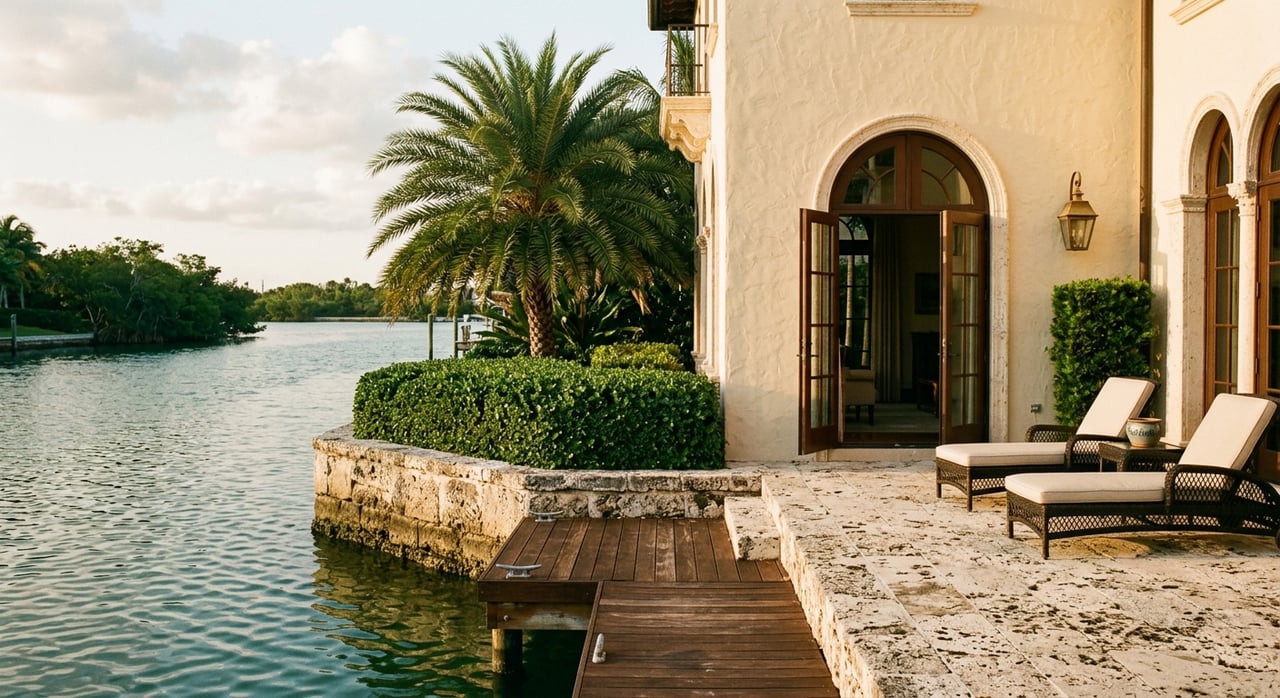
If you are buying on the water in Gables By The Sea, the view is only the beginning. What really shapes your day-to-day ownership is how the canal works for your boat, how the lot handles outdoor living, and what the flood, permit, and gate details look like before you close. If you ask the right questions early, you can move forward with more clarity and fewer surprises. Let’s dive in.
Gables By The Sea appeals to buyers who want a gated Coral Gables setting with direct access to the water and a strong indoor-outdoor lifestyle. But waterfront homes ask more of your due diligence than a similar home off the water.
In this neighborhood, the smartest questions usually come down to five areas: route to bay, bridge clearance, dock and seawall history, flood and insurance costs, and lot-use flexibility. Those issues can affect how you use the property, what upgrades are possible, and what your long-term carrying costs may be.
For many buyers, the first question is simple: can you actually get your boat from the dock to open water without a problem? Coral Gables notes that its canal system connects to Biscayne Bay and that most city waterways are navigable by boat, but navigable does not mean every vessel fits every route.
That is why route planning matters. The practical test is not just whether the home is waterfront, but whether the path from the dock to the bay works for the boat you plan to keep there.
Coral Gables publishes bridge-clearance data that ranges from 7 to 21 feet. Some key published clearances include Old Cutler Road at 15 feet, US-1 at 8 feet, and Lugo Avenue at 9.5 feet.
If your vessel has height requirements that push those limits, a beautiful dock may not solve the real issue. Before you make an offer, confirm the route and compare it against the actual dimensions of your boat, not an estimate.
Boating convenience is also about how easy the property feels on a regular Tuesday, not just on a perfect weekend. A dock’s position, turning space, and exposure to wake can all affect how comfortable you feel coming and going.
Privacy matters too. Depending on the lot’s location along the waterway, you may notice a different feel in terms of visibility from neighboring homes, maneuvering room, and activity on the canal.
Matheson Hammock Park & Marina is another useful point of reference for life in this area. The city describes it as a 630-acre urban park with an atoll pool, beach, full-service marina, restaurant, picnic pavilions, nature trails, and sailing and power-boat school.
Even if you plan to keep a boat at home, nearby marina access can still matter. It can shape how you think about trailering, lessons, guest outings, or a backup plan for certain types of boating activity.
On waterfront property, the rear yard has to do a lot. You may want a dock, pool, terrace, outdoor kitchen, lawn space, privacy landscaping, and room to move comfortably between them.
That is why lot configuration deserves as much attention as the interior floor plan. A home can show beautifully online and still have real constraints once you map out how you want to live there.
Coral Gables treats docks, moorings, and wharves as permit work. The city requires a specific permit process for seawalls, bulkheads, docks, and decks, including site plans, sections and details, dock location, dimensions across the waterway, existing mangroves, and preliminary Miami-Dade DERM approval.
For you as a buyer, the takeaway is straightforward: ask whether the dock, seawall, bulkhead, lift, and any related work were properly permitted and finaled. If improvements were added or modified over time, that paper trail matters.
Pool and spa projects are also permit-heavy in Coral Gables. The city requires site plans, pool barriers, and stormwater, erosion, and sedimentation controls.
If you are dreaming of adding a pool, spa, pergola, or summer kitchen, confirm what the lot can realistically accommodate. Setbacks, safety requirements, and the location of existing features can all shape what is possible.
Coral Gables encourages landscape buffer zones along waterways, and mangroves are protected under state law. The city notes that most mangrove trimming requires a Miami-Dade County certified and registered professional mangrove trimmer, with DERM handling permits and trim guidance.
This becomes especially important when privacy landscaping, pool placement, and dock design all compete for the same space. A rear yard that looks flexible at first glance may have real limitations once environmental and permitting rules are considered.
On any waterfront purchase in Coral Gables, flood review should happen early. The city states that the area is especially susceptible to flooding from major rain events and storm surge, and it also notes that standard homeowners insurance does not cover flood damage.
That means flood-zone verification is not something to save for later. It belongs in your offer-stage due diligence along with your insurance review.
Coral Gables provides Flood Insurance Rate Maps, elevation certificates, and flood-protection guidance. Those details can help you understand how the property is classified and how that may affect future insurance costs.
A current elevation certificate can be especially helpful when you are comparing one waterfront home against another. Two properties in the same general area may present very different insurance and risk profiles.
The city notes that flood policies generally take effect 30 days after purchase. It also states that FEMA’s Risk Rating 2.0 bases pricing on building characteristics and proximity to flood sources.
In practical terms, you should ask for the seller’s current flood insurance information and obtain your own quote as part of due diligence. That gives you a more accurate picture of monthly ownership costs before you are fully committed.
Coral Gables frames sea-level rise as a long-term resilience issue for its coastlines and canals. The city notes that it monitors inland and coastal waterways, including stations near Blue Road, the Islands of Cocoplum, and Matheson Hammock Park and Preserve.
For a long-term owner, this is part of the bigger ownership picture. You are not just buying a home for today’s lifestyle, but also evaluating how the property fits your risk tolerance and planning horizon.
In gated waterfront areas, the purchase price is only part of the financial picture. You should also confirm whether there is a special taxing district, gate-related process, or assessment that affects carrying costs.
Coral Gables’ special taxing district portal notes that gate decals and devices are issued only after application and residency documentation. The city’s finance function also tracks special assessments and related fees.
Before closing, ask what the current district assessment is, how gate access is issued, and whether there are transfer steps or timing considerations for a new owner. These may not be major obstacles, but they are details worth understanding in advance.
If there are additional association rules or architectural review requirements beyond city rules, those should be reviewed as well. On a luxury purchase, smooth ownership often comes down to how well the details were handled before closing day.
For many buyers, school planning is part of the long-term decision, even when the purchase is driven first by waterfront lifestyle. In Coral Gables, school assignment should always be verified by the specific property address.
The city notes that residents have access to many highly rated public schools and that most Coral Gables schools have A or B ratings. It also identifies Coral Gables Preparatory Academy and Pinecrest Elementary as nearby public options with an A grade on the district’s 2024-25 dashboards, and lists Miami Palmetto Senior High in Pinecrest as another nearby option.
Miami-Dade County Public Schools assigns students based on where parents or guardians live unless a transfer or choice option applies. That means a neighborhood name alone is not enough to confirm public school assignment.
If school planning matters to your move, verify the assigned public school for the exact address. That is the most reliable way to align the home search with your day-to-day logistics.
Gulliver Prep is another nearby option that may be relevant for some families. Its PK-8 campus is in Coral Gables, and its upper school campus is in Pinecrest.
Even if you are still weighing public and private paths, commute patterns matter. Think about how school drop-off, boating plans, park use, and daily driving fit together over the course of a normal week.
When you tour a waterfront home in Gables By The Sea, it helps to walk in with a focused checklist. That keeps the showing grounded in how the property will actually function for you.
Use these questions as a starting point:
Waterfront real estate in Coral Gables is never just about finishes and frontage. It is about how boating access, permitting, resilience, and neighborhood logistics come together in one purchase decision.
In a community like Gables By The Sea, the best buying decisions usually come from asking sharper questions earlier. If you want a thoughtful, concierge-level approach to evaluating waterfront homes in Coral Gables, Jessica Adams Luxury Real Estate can help you search with clarity and confidence.
We've got more to share with you.
September 3, 2026
October 22, 2026
October 22, 2026
October 8, 2026
September 17, 2026
September 10, 2026
A New Home Changes Everything.