Ponce Davis vs Pinecrest Estates: Find Your Best Fit
July 2, 2026
July 2, 2026
Choosing between Ponce-Davis and Pinecrest is not just about square footage or lot size. It is about how you want your daily life to feel, how much structure you want around you, and what kind of estate setting fits your priorities. If you are weighing both neighborhoods, this guide will help you compare their identity, housing character, convenience, and long-term lifestyle fit so you can make a more confident decision. Let’s dive in.
Both Ponce-Davis and Pinecrest are known for low-density residential character and larger homesites, but they offer very different living experiences. Ponce-Davis functions as a quiet estate enclave within unincorporated Miami-Dade County, while Pinecrest is an incorporated village with its own government, services, parks, and civic rhythm.
That difference matters more than many buyers expect. In one neighborhood, you are buying into scarcity and privacy. In the other, you are buying into estate-scale living with a deeper municipal framework around it.
Ponce-Davis is part of Miami-Dade County’s unincorporated municipal service area. In county annexation materials, the combined High Pines and Ponce-Davis area is described as bounded by SW 72nd Street, SW 57th Avenue, SW 88th Street, and SW 47th Avenue.
The county’s land-use records show a predominantly residential area with a strong estate orientation. One county report describes Ponce-Davis as 95 percent single-family, while related annexation material describes the broader area as largely estate-density and low-density residential. In practical terms, that supports what many buyers already sense when they drive the neighborhood: Ponce-Davis reads as a quiet, low-density pocket rather than a mixed-use district.
Ponce-Davis tends to appeal to buyers who want discretion and a more tucked-away setting. Because the area is essentially built out, available opportunities can feel limited, which adds to its tightly held character.
That scarcity is part of the appeal. If you value privacy, mature surroundings, and a neighborhood that feels more like an enclave than a village center, Ponce-Davis often stands out.
You may prefer Ponce-Davis if your priorities include:
For many luxury buyers, that combination creates a strong sense of retreat without feeling remote.
Pinecrest is an incorporated village created on March 12, 1996. The village reports that it covers about eight square miles, has roughly 18,388 residents, and is governed by a five-member council under a council-manager system.
Its boundaries are generally Snapper Creek Canal to the north, SW 136th Street to the south, SW 57th Avenue to the east, and Pinecrest Parkway to the west. Pinecrest also has a clear civic footprint, including its Municipal Center and police station on Pinecrest Parkway, which reinforces its identity as a self-governing municipality.
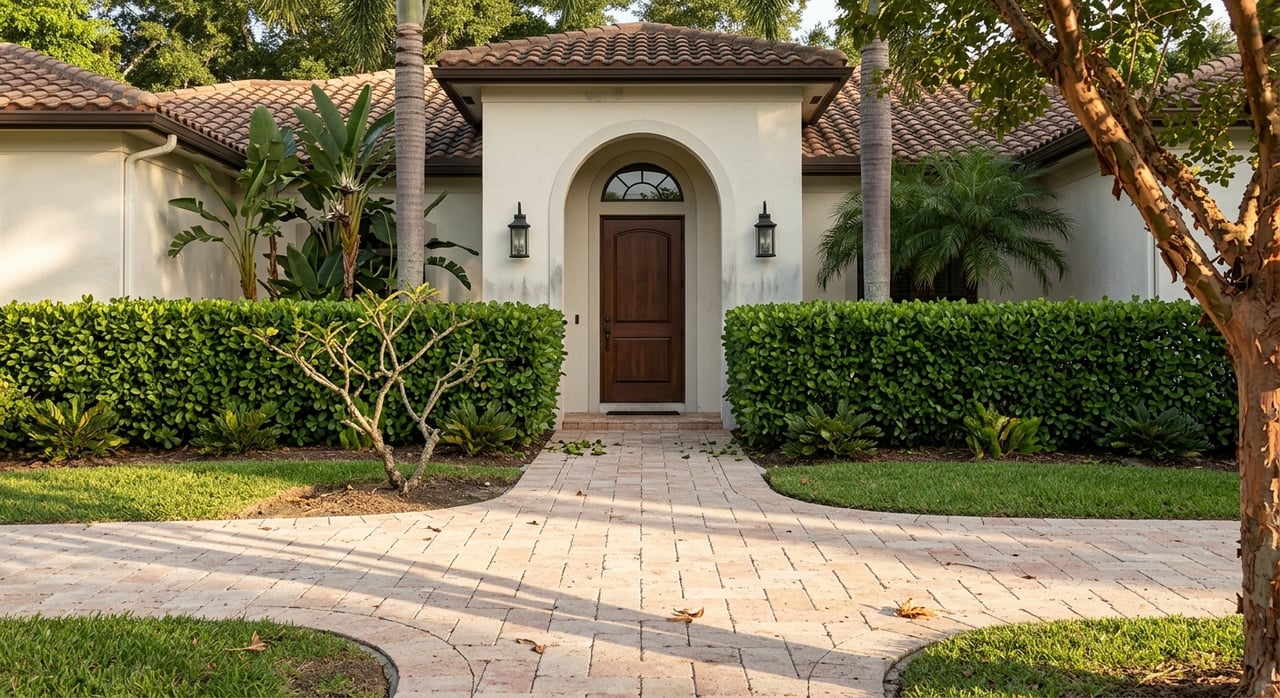
Pinecrest’s residential identity grew around ranch-style homes on acre lots in the 1950s and 1960s, according to the village history. That pattern helps explain why the area still feels lush, spacious, and established today.
The village also describes itself as known for tree-lined streets and large estate lots. Compared with Ponce-Davis, Pinecrest often feels broader and more systematized, with a stronger sense of municipal planning and service structure.
You may prefer Pinecrest if your priorities include:
For buyers who want estate living without giving up a stronger public amenity layer, Pinecrest can feel like a natural fit.
Both neighborhoods support an estate lifestyle, but they express it differently. Ponce-Davis feels shaped by scarcity, privacy, and the fact that it is largely built out. That can make each property feel highly site-specific, with lot quality and setting carrying extra weight.
Pinecrest, by contrast, has a more legible estate framework. Its history of ranch homes on larger lots, along with its tree-lined streets and broader village footprint, creates a more expansive suburban estate feel.
In Ponce-Davis, the draw is often the neighborhood itself. Buyers are frequently responding to a low-density setting, established surroundings, and the rarity of available homes.
That can make the search more nuanced. In a built-out enclave, details like privacy, landscaping, access, and the quality of the homesite can matter just as much as the home’s interior finishes.
In Pinecrest, buyers often find a more consistent pattern of larger residential lots and a village-wide estate atmosphere. The setting can feel more expansive, with a stronger sense of repetition in lot scale and streetscape character.
That does not mean every property is the same. It means the overall neighborhood framework is easier to understand if you want estate living in a more visibly planned municipal setting.
One of the clearest differences between these neighborhoods is the amenity layer around the homes. Pinecrest offers a deeper built-in network of parks, recreation, civic spaces, and local businesses.
The village says more than 750 businesses line its western US 1 boundary. It also operates a substantial parks system that includes Coral Pine Park, Evelyn Greer Park, Flagler Grove Park, Pawcrest Park, Pinecrest Community Center, Red Road Linear Park, Suniland Park, and Veterans Wayside Park.
Pinecrest Gardens is one of the village’s defining destinations. The village describes it as a 14-acre botanical garden and event venue on the former Parrot Jungle site, and says it now welcomes more than 140,000 visitors each year.
The Pinecrest Community Center adds another layer of everyday utility with a fitness room, programs, meeting rooms, spinning, and a playground. For many buyers, these features make Pinecrest feel like more than an estate neighborhood. It feels like a village with active public life.
Ponce-Davis offers a different kind of appeal. Because it is governed as part of unincorporated Miami-Dade County, county services take the place of a village government structure.
County annexation materials also noted a need for a neighborhood park and urban open spaces in the High Pines and Ponce-Davis area. That suggests a thinner amenity layer than what you find in Pinecrest, which may be a positive or a drawback depending on your lifestyle.
If you want a more self-contained residential feel, that quieter rhythm may suit you. If you want public amenities built into the neighborhood experience, Pinecrest has the clearer edge.
Your day-to-day experience is shaped by more than the house itself. Governance, transportation options, and service delivery can influence how a neighborhood feels over time.
Ponce-Davis sits closer to the urban core by geography than Pinecrest does, based on county boundary descriptions and its adjacency to Coral Gables on multiple sides. That can translate into a more central-feeling routine for buyers who spend time in nearby core neighborhoods.
Pinecrest operates its own police department and 911 answering point. The village also offers the free Pinecrest People Mover, which links neighborhoods and schools and connects riders to Metrobus, as well as Freebee, a free on-demand ride service that connects village destinations to the South Dade Transitway and Metrorail station.
Those systems give Pinecrest a stronger municipal ecosystem. If you value visible local infrastructure and service depth, that can be a meaningful advantage.
In the High Pines and Ponce-Davis area, Miami-Dade Fire Rescue service comes from South Miami Station 14 and Pinecrest Station 49, according to annexation records. The area’s service structure is county-based rather than village-based, which creates a different civic feel.
Neither approach is inherently better. It simply depends on whether you want a more formal municipal framework or a quieter county-managed enclave.
If your top priorities are privacy, scarcity, and a more tucked-away estate setting, Ponce-Davis may be the stronger fit. It tends to resonate with buyers who want a low-density residential pocket that feels close in, discreet, and tightly held.
If your priorities include estate-scale homes, parks, civic amenities, village services, and a stronger public identity, Pinecrest may be the better match. It offers a broader ecosystem around daily life while still delivering the spacious residential character luxury buyers often want.
The right choice comes down to how you want your home to support your life. Some buyers want the calm and rarity of a secluded estate pocket. Others want the same sense of space with more structure, services, and community resources around them.
When you are comparing neighborhoods at this level, the details matter. The team at Jessica Adams Luxury Real Estate offers a white-glove, design-aware approach to help you evaluate not just the home, but the fit, feel, and long-term value of the neighborhood itself.
We've got more to share with you.
September 17, 2026
Neighborhoods
June 25, 2026
September 10, 2026
July 16, 2026
September 3, 2026
A New Home Changes Everything.