Brickell's Real Calendar Isn't the Skyline. It's Saturday.
August 13, 2026
August 13, 2026
Walk south from the Miami River on a Tuesday afternoon and Brickell reads exactly like its reputation: glass towers stacked shoulder to shoulder, a financial district with palm trees, a place that looks like it was poured from a mold last Tuesday. Then you turn onto South Miami Avenue, and there is a six-foot limestone wall, a canopy of gumbo limbo and strangler fig, and a garden that has been standing since 1913. The towers around it are, on average, younger than most of their own doormen. The forest is 113 years old.
That contradiction is the actual shape of the neighborhood, and it explains something residents figure out only after a few months here: Brickell does not run on one clock. It runs on at least four, stacked on top of each other, and most people who live here have only ever synced up with one.
Ask a Brickell resident where to find the neighborhood's weekend market and you will get a confident, specific answer. Ask three residents and you may get three different answers, and all three will be correct, because Brickell does not have a Saturday market. It has three, on three different schedules, run by three different operators, and they are not interchangeable.
| Market | Location | Schedule | Character |
|---|---|---|---|
| Mary Brickell Village Saturday Market | Level 1, S. Miami Avenue | Every Saturday, 10am to 5pm | Handmade goods, street food, sweet treats, woven into the shopping center's regular foot traffic |
| Brickell City Centre Farmers Market | Under the Metromover track | Every Saturday | Fruit stands, artisanal goods, pet products, live music |
| Brickell Farmers & Artisanal Market at The Underline | Backyard Promenade, across from Mary Brickell Village | Second and fourth Saturday only | Insured, permitted vendor stalls tied to Miami-Dade County's linear park programming |
The Mary Brickell Village Saturday Market runs every week without exception. The Underline's market does not. It shows up twice a month on a schedule set by its vendor agreement with Miami-Dade County, which means the Saturday that works perfectly for the Village market can be the wrong Saturday for The Underline. Anyone who tells you they "go to the farmers market" on Saturdays and means one specific stretch of pavement is, without realizing it, describing a fraction of what is actually available two blocks away.
This is not a trivia point. It is the clearest evidence that Brickell's density did not erase its texture, it multiplied it. A neighborhood with one market has one identity. A neighborhood with three, each keyed to a different rhythm, requires you to actually live inside its calendar to know what is happening where. That is the kind of knowledge a postcard cannot give you and a listing photo cannot show you.
Back to that wall on South Miami Avenue. Simpson Park is a compact fragment of what was once the Brickell Hammock, a stretch of tropical hardwood forest that once stretched from the Miami River down toward Coconut Grove before the city filled in around it. It is named for Charles Torrey Simpson, a botanist who arrived in Miami in 1881 to study the region's flora and fauna, and the park itself was established by local preservationists in 1913. More than 160 plant species live inside its walls, including several listed as threatened or endangered, tucked into live oaks, silver palms, and strangler figs that predate every building on the block.
The park keeps limited hours and does not advertise itself. There is no rooftop bar attached, no branded activation, no reason for a visitor passing through for a long weekend to know it exists. But residents who have found it treat it the way people in older, slower cities treat a neighborhood chapel: as the one fixed point that does not move while everything around it gets rebuilt.
A few blocks away, Brickell Park does something similar on a smaller scale. The 2.5-acre park along Brickell Avenue sits inside a designated archeological zone and holds the Brickell Mausoleum, the last surviving structure connected to William and Mary Brickell's original homestead, the family the neighborhood is named for. Between Simpson Park's old-growth canopy and Brickell Park's mausoleum, the densest, newest-looking neighborhood in Miami is quietly built around two of the oldest continuously preserved sites in the city. That is not a coincidence residents stumble into. It is something you learn by walking the same three blocks often enough to notice what does not change.
Layer a third schedule on top of the market rotation and the hammock's limited hours: Miami Spice. The city's long-running prix-fixe dining promotion is marking its 25th anniversary this year, running from August 1 through September 30 with more than 300 participating restaurants citywide, Brickell included. The format has also shifted for 2026. Alongside the usual $40 lunch and $50 to $65 dinner menus, this year introduces Miami Spice Reserve, a new $95 tier for restaurants offering a more elevated version of the promotion. That is a meaningful jump from the program's traditional price ceiling, and it signals that some of Brickell's dining rooms now see enough demand to charge nearly double the old top rate and still fill tables.
This two-month window is when Brickell's food identity briefly flips. One Brickell dining room built its menu around a minimum of 10 grams of ossetra caviar on every dish, which is how its fried chicken ends up costing $74 on a normal night. For two months, tables like that become accessible at a fixed, predictable price. It is the closest thing Brickell has to an open house for its own restaurant scene, and it only happens once a year.
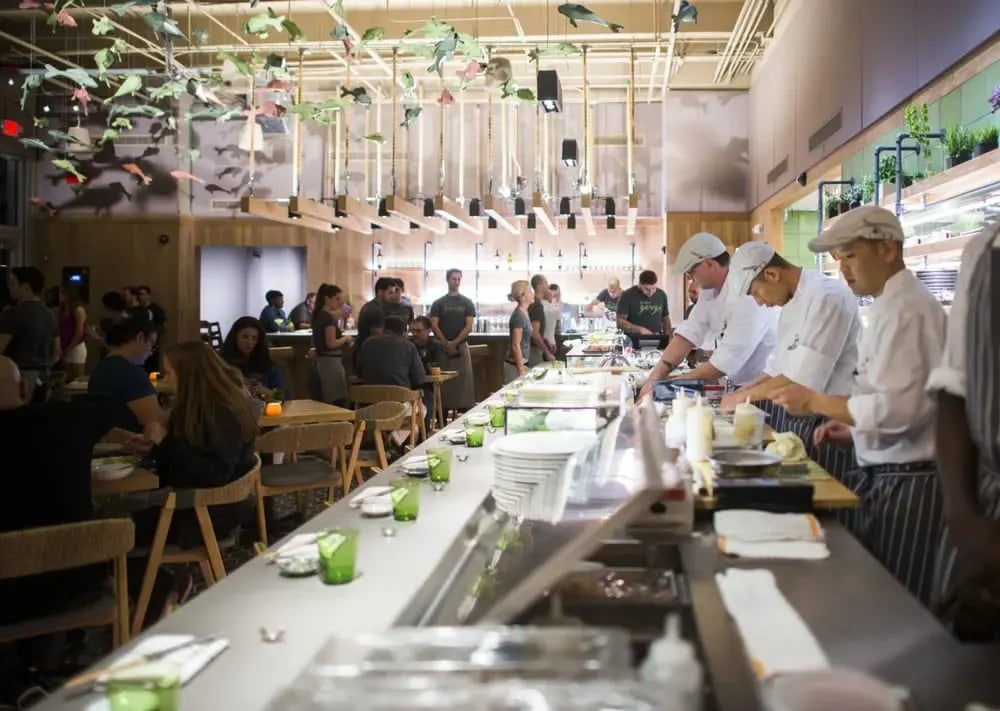
The restaurants themselves have been shifting too. Brickell's dining reputation used to run on arepas and croquetas. It still does, but the newer wave leans in other directions entirely. Amazónico, the Latin American concept from Sandro Silva and Marta Seco that originated in Madrid and has since opened in London, Dubai, and Monte Carlo, made its U.S. debut in Brickell this year, bringing live music and a rooftop lounge alongside a menu built around Amazon-region ingredients. On Brickell Avenue, the "clubstaurant" Claudie has become one of the neighborhood's hardest reservations, pairing French-Mediterranean plates with cabaret-style performers roaming the dining room. A few blocks over, PopUp Bagels, the Connecticut-born chain with a cult East Coast following, is set to open its first Brickell location at 801 Brickell this summer, following an Aventura debut in late April.
None of these openings alone would mean much. Together, they describe a neighborhood whose food scene has grown fast enough to sustain both a $95 tasting menu and a bagel shop opening in the same six-month window, and confident enough to import a Madrid brand's first American location rather than waiting for it to prove itself elsewhere first.
Put the three threads next to each other and the pattern becomes obvious. Brickell's markets run on three separate schedules that do not overlap the way people assume. Its oldest green spaces operate on limited hours that most newcomers never learn. Its dining scene runs on an annual two-month promotional cycle that temporarily reshuffles which restaurants are worth the reservation. None of these systems announce themselves from the street. You have to actually be here, on a regular Saturday, checking which market is running this week, to know how the neighborhood actually moves.
That is worth remembering the next time someone describes Brickell purely by its skyline, its Metromover loop, or its reputation as Miami's financial core. The buildings are the least interesting thing about how the neighborhood actually functions week to week. The interesting part is underneath: a forest that has outlasted every tower around it, a market circuit that rewards people who pay attention to which Saturday it is, and a dining scene currently running two menus at once, one seasonal and temporary, one permanent and expanding.
If you are weighing a move into Brickell, or already call it home and are curious how its rhythms compare to Coral Gables, Coconut Grove, or the quieter enclaves further south, the team at Jessica Adams Luxury Real Estate spends its days inside exactly this kind of neighborhood detail. Start Your Luxury Search when you are ready to talk specifics.
We've got more to share with you.
September 17, 2026
Neighborhoods
June 25, 2026
September 10, 2026
July 16, 2026
September 3, 2026
A New Home Changes Everything.