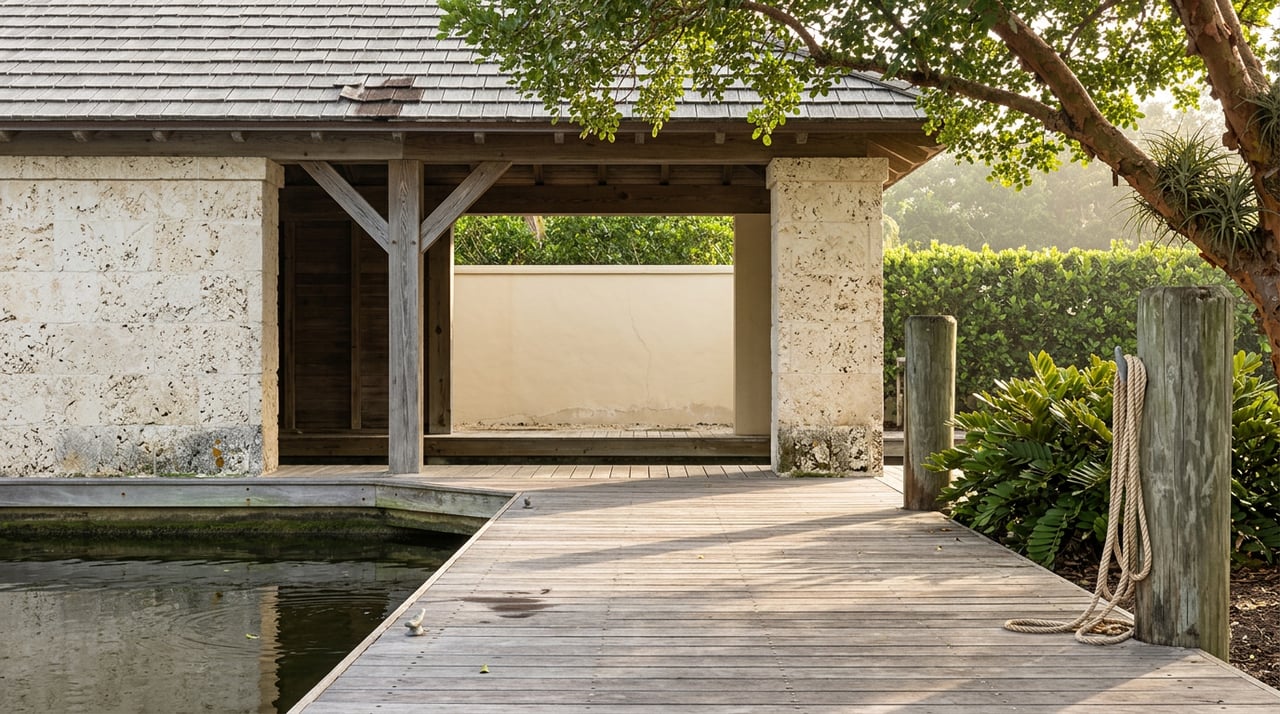
Why Homes in The Moorings Rarely Change Hands
August 20, 2026
August 20, 2026
According to Profile Miami, in 2022, a 1929 Mediterranean revival villa at 3467 Moorings Way changed hands twice in twelve months. First for $12.8 million. Then, in an off-market deal, for $14.7 million, or $2,345 per square foot, a record for a non-waterfront home anywhere in Coconut Grove. The house was designed by Walter De Garmo, the architect who helped define the look of 1920s Miami. The buyer worked with Renier Casanova at Compass. The seller worked with Jorge Uribe at One Sotheby's. Neither side needed a yard sign or an open house to get there.
That sale tells you more about The Moorings than any median price ever could. This is a guard-gated enclave off Main Highway with somewhere between 37 and 43 homes, depending on which record you trust, and even that disagreement is a clue. When multiple professional sources can't settle on a home count for a neighborhood this small, it usually means the properties inside it don't move often enough for anyone to keep a clean running tally.
They don't. The Moorings sees two to three home sales a year. Across a maximum of 43 homes, that is a low turnover rate.
The obvious story is the one every listing description repeats: privacy, water access, mature trees, a hundred-year pedigree. All true. None of it explains why turnover here runs lower than in comparably priced Grove enclaves that share the same privacy, water access, and pedigree.
The real answer is structural, and it starts with how the community was built. In the early 1920s, when a developer carved The Moorings out of land once owned by Frank Church and Jessie Moore, it became the only subdivision in Coconut Grove to adopt the 1920 Bright Plan, the same City Beautiful era planning philosophy that gave Coral Gables its boulevards and civic order. That meant a 100-foot boulevard with a planted median, an entrance fountain, curving roads, and shared dock access built into the plan from day one. Nowhere else in the Grove got that treatment.
What that history produced isn't just a prettier street grid. It produced a community designed around permanence rather than turnover: shared infrastructure that only works if the same small group of families keeps funding it together, generation after generation. That's a very different starting point from a subdivision built purely for individual lot sales.
Here's where the incentive structure gets concrete. A private, guard-gated community this size still has to pay for the guard, the private roads, the small park, and the marina. Industry sources following Coconut Grove's gated enclaves in 2026 note that dues in the smallest communities get split across very few homes, which means the per-household cost can run higher than a buyer coming from a larger association would expect.
That math cuts both ways. An owner who bought decades ago, before waterfront insurance and dues climbed to today's levels, has little financial reason to sell into a market where their replacement home elsewhere would cost more to carry, not less. A buyer stepping in today inherits that same dues structure at current pricing, with none of the decades of appreciation cushion the seller built up. The economics reward staying put far more than they reward trading up or out.
Older homes in The Moorings can call for particular due diligence.
According to Million Luxury, Florida has required flood-risk disclosures before contract execution since October 1, 2024. For a waterfront estate built in the 1920s or 1930s, that disclosure runs straight into a second problem: Miami-Dade County has only required Elevation Certificates for permitted construction since 1995. A house built decades before that requirement existed may simply never have had one commissioned, which means a buyer's insurer is pricing a policy on incomplete information until someone pays for a fresh survey.
These considerations can affect the time and negotiating leverage involved in a sale. For a seller who does not need to move, they may factor into the decision about when to sell.
The Moorings isn't the only Grove gated community built on scarcity, but the flavor of scarcity differs sharply once you look at what's actually changed hands.
| Enclave | Approximate home count | Most notable recent sale | What defines it |
|---|---|---|---|
| The Moorings | 37 to 43 | 3467 Moorings Way, 1929 De Garmo villa, $14.7M ($2,345/sq ft) in 2022 | Private marina, generational ownership, 2-3 sales a year |
| Camp Biscayne | roughly 26 | Rarely surfaces publicly | Former 1920s winter resort, giant oak canopy, off-market culture |
| Hughes Cove | 9 to 15 | Rarely surfaces publicly | Smallest footprint in the Grove, bridge-free bay access, boating-first buyers |
| The Anchorage | 5 to 8 | Banyan Ridge, 3585 Anchorage Way, $101.5M in late 2025 | The Grove's price ceiling, almost never listed at all |
Read across that table and a pattern emerges. Home count and price ceiling move independently of each other. The Anchorage has the fewest doors and the highest recorded sale in the group. The Moorings has the most doors of the four and still manages the lowest reported turnover in raw transaction count. Scarcity in the Grove takes different forms. In The Moorings, long-term ownership and shared infrastructure are part of the low-turnover picture, alongside the enclave's size.
If the strategy is "wait for a listing to appear and move fast," the 3467 Moorings Way sale shows that not every sale follows that route. That house never appeared as a public listing at its final price. It moved through relationships between agents who already knew the property and the buyer pool.
A more useful approach starts with the paperwork before a house exists to buy:
None of this guarantees access. Nothing about a market that trades two or three times a year guarantees anything. But it changes the odds from waiting for luck to being ready when the conversation happens.
Do homes in The Moorings ever show up on public listing sites? Occasionally, but the enclave's benchmark sale in 2022 happened off-market, and that pattern holds for much of what trades here. Public listings are the exception, not the default entry point.
Why would an 80-to-100-year-old house need an Elevation Certificate at all? Because Miami-Dade County has required them for permitted construction only since 1995, meaning many of The Moorings' original 1920s and 1930s estates predate the requirement entirely. Combined with Florida's flood-disclosure law taking effect October 1, 2024, that gap has become something buyers and sellers now have to address before, not after, signing a contract.
Understanding a market like The Moorings takes more than watching for a new listing. It takes knowing the HOA, the flood-zone history, and the families who've held these addresses for decades, which is exactly the kind of ground-level intelligence Jessica Adams Luxury Real Estate brings to every Coconut Grove conversation. If you're serious about a gated address in the Grove, reach out and start your luxury search before the next quiet deal closes without you.
This article is general information, not legal, tax or financial advice. Consult a qualified professional about your situation.
We've got more to share with you.
October 8, 2026
September 17, 2026
September 10, 2026
October 1, 2026
September 3, 2026
August 20, 2026
A New Home Changes Everything.